
Why The New Omega Moonwatch Reserve Panda Matters
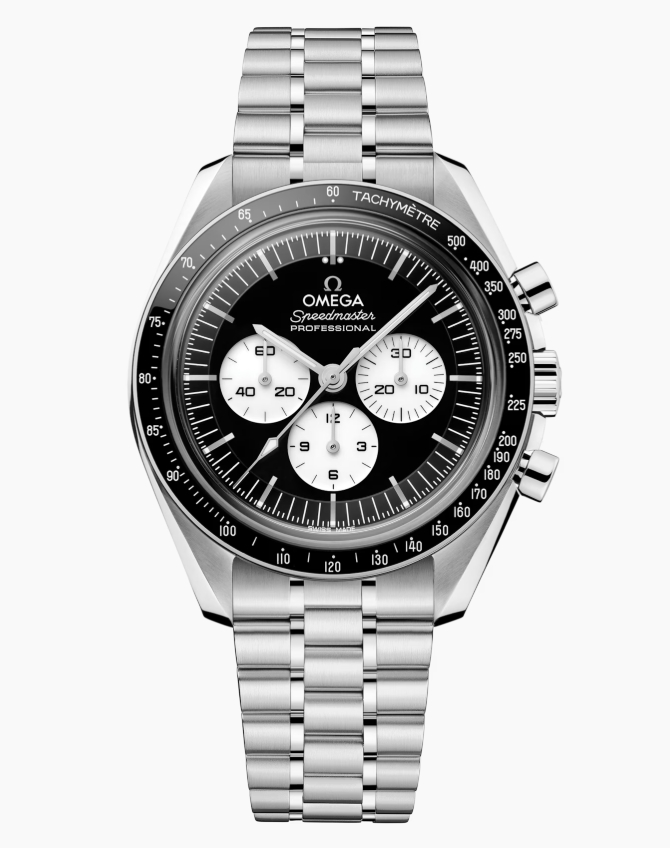
In a luxury watch market increasingly dominated by conversations about scarcity, premiums, and secondary-market performance, Omega’s latest Speedmaster Moonwatch release arrives with a notably different tone. The new reverse panda configuration does not attempt to manufacture urgency or exclusivity. Instead, it reflects a brand comfortable with its position, offering a measured evolution of one of the most recognizable chronographs in modern horology.
The reverse panda dial—defined by a black main dial contrasted with white subdials—has become a familiar visual language, particularly through its long association with the Rolex Daytona. Omega’s interpretation avoids overt comparison by remaining firmly rooted in the Speedmaster’s tool-watch heritage. A glossy black lacquer dial adds depth and modern polish, while recessed white subdials introduce contrast without disrupting the watch’s disciplined symmetry. Legibility, long a defining characteristic of the Moonwatch, remains central, reinforced by crisp printing, applied markers, and white Super-LumiNova.
Material upgrades are present but restrained. The black ceramic tachymeter bezel, finished with white enamel numerals, enhances durability and visual clarity without altering the watch’s identity. The 42mm stainless steel case retains the familiar proportions and twisted-lug design that have defined the Moonwatch for decades, signaling continuity rather than reinvention.
The timing of this release is particularly significant. Omega is still benefiting from the extraordinary success of the MoonSwatch collaboration, which propelled the Speedmaster design into the mainstream in a way few traditional watch launches ever have. That project did more than generate long lines and social media attention; it introduced the Moonwatch silhouette to a global audience far beyond traditional collectors. Rather than diminishing the prestige of the mechanical Speedmaster, the collaboration reinforced its cultural relevance and broadened its appeal.
The reverse panda Moonwatch appears to build on that momentum, translating renewed attention into a refined luxury offering. It provides a fresh visual identity for seasoned enthusiasts while remaining approachable to newcomers whose first exposure to the Speedmaster may have been through a far more affordable, playful interpretation.
From a financial perspective, the watch occupies a notably pragmatic position. Priced well below a modern Rolex Daytona and readily available through authorized channels, it sidesteps the increasingly complex dynamics of luxury watch acquisition. There are no waitlists, no relationship requirements, and no implicit promises of future value appreciation. In an industry where scarcity often drives desirability, Omega’s strategy emphasizes consistency and accessibility.
Historically, the Speedmaster has performed as a stable, long-term value rather than a speculative asset. It typically experiences modest depreciation before settling into steady demand, supported by its historical significance rather than market hype. The reverse panda configuration is unlikely to alter that pattern, and Omega appears untroubled by the absence of speculative fervor. This is a watch intended to be worn regularly, not stored in anticipation of market shifts.
Inevitably, comparisons with Rolex linger in the background. The Daytona’s reverse panda variants have become symbols of both status and scarcity, frequently discussed as much for their market value as for their design. Omega’s response is understated but deliberate. By offering a reverse panda chronograph grounded in transparency and availability, the brand presents an alternative vision of luxury—one where ownership is immediate rather than aspirational. The contrast is quietly humorous: one buyer is monitoring price trends, while the other is already wearing the watch.
Mechanically, Omega maintains its commitment to tradition. The manual-wind Co-Axial Master Chronometer movement remains unchanged, preserving the tactile engagement that has long defined the Moonwatch experience. In a segment increasingly dominated by automatic movements and convenience-driven features, the act of daily winding feels intentional, reinforcing the watch’s connection to its past.
The reverse panda Speedmaster Moonwatch ultimately succeeds not by challenging the market’s obsession with scarcity, but by ignoring it. Informed by decades of heritage and buoyed by the cultural resurgence sparked by the MoonSwatch, Omega delivers a chronograph that balances modern design with historical integrity. It may never command dramatic premiums on the secondary market, but it offers something increasingly rare in contemporary watchmaking: confidence without pretense, and value measured in wearability rather than speculation.
-D.Sikoff